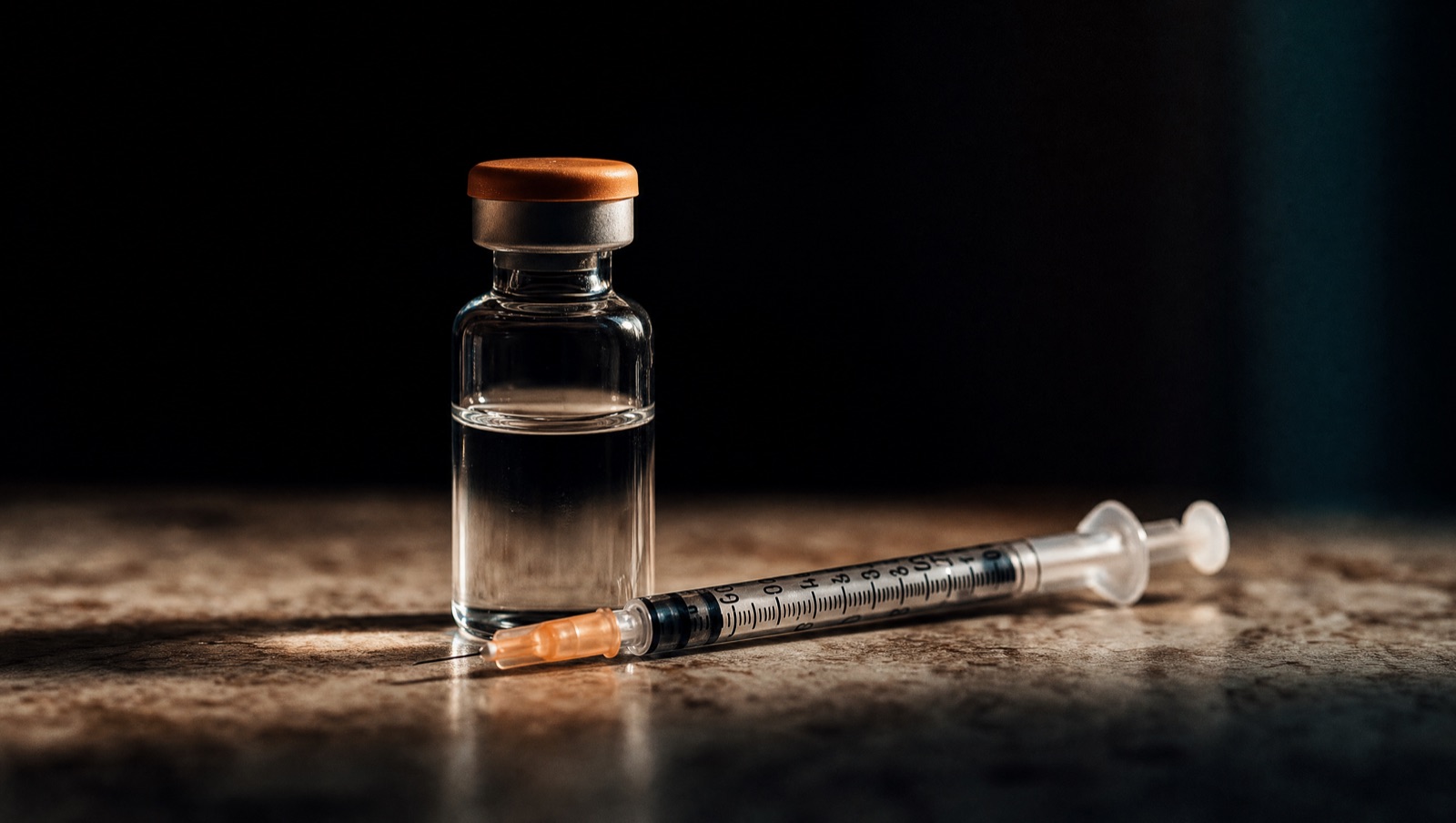
Reconstitution Math: Concentration, mL, and U-100 Units
Before calculating, verify the exact product, labeled final concentration, prescribed amount, and measuring device.
- Use the final concentration stated in the product or pharmacy instructions; do not invent a diluent volume.
- Match the mass units first: convert mcg to mg when needed, then calculate volume (mL) = amount (mg) ÷ concentration (mg/mL).
- On a U-100 insulin syringe, the mark labeled 1 corresponds to 0.01 mL; this is not a universal volume or peptide unit.
- A correct calculation cannot confirm the product, diluent, prescribed amount, preparation method, or storage conditions.
Before using any formula: verify the exact product, its labeled final concentration, the prescribed amount, and the measuring device. If any value is missing or conflicts with another source, stop and ask the dispensing pharmacist or prescriber.
Reconstitution math connects three different quantities:
- Mass — the amount of substance, commonly written in milligrams (mg) or micrograms (mcg).
- Volume — the amount of liquid, commonly written in milliliters (mL).
- Concentration — mass per volume, such as mg/mL.
They are related, but they are not interchangeable. A mass cannot be converted to mL or syringe markings without a verified concentration.
Start with the labeled final concentration
Use the final concentration stated in the product labeling or pharmacy instructions. Do not choose a diluent or volume from a generic chart.
When authoritative instructions state the final concentration, use that value directly. Do not infer final volume from the amount of diluent unless the instructions explicitly define the resulting volume.
The three core formulas
1. Concentration
When the instructions provide total mass and final volume:
concentration (mg/mL) = total mass (mg) ÷ final volume (mL)2. Volume for a prescribed amount
volume (mL) = prescribed amount (mg) ÷ concentration (mg/mL)If the prescribed amount is in micrograms and the concentration is in mg/mL, convert mcg to mg first:
1 mg = 1,000 mcg
amount in mg = amount in mcg ÷ 1,000
3. U-100 insulin-syringe conversion
On a U-100 insulin syringe, the mark labeled 1 corresponds to 0.01 mL because the syringe is calibrated for insulin at 100 units/mL:
U-100 syringe mark = volume (mL) × 100
volume (mL) = U-100 syringe mark ÷ 100
Use this relationship only when the specified device is a U-100 insulin syringe. The marking is not a universal volume unit, peptide amount, or biological-activity unit.
Worked arithmetic example
This example demonstrates the arithmetic only. It is not a dose or preparation recommendation.
Assume the verified instructions state a final concentration of 2 mg/mL, and the prescribed amount is 250 mcg.
- Convert 250 mcg to mg:
250 ÷ 1,000 = 0.25 mg. - Divide by concentration:
0.25 mg ÷ 2 mg/mL = 0.125 mL. - If the specified device is a U-100 insulin syringe:
0.125 mL × 100 = 12.5 units.
Reverse-check the result:
0.125 mL × 2 mg/mL = 0.25 mg = 250 mcgWhat the calculation cannot verify
Arithmetic alone cannot confirm:
- that the product should be reconstituted;
- which diluent and volume are compatible with it;
- that the concentration was copied correctly;
- that the prescribed amount is appropriate;
- that the measuring device matches the intended scale;
- how the product should be mixed, stored, or discarded; or
- whether an unexpected appearance indicates a problem.
Those details must come from the product instructions, dispensing label, pharmacist, or prescriber.
When to stop
Do not proceed when:
- the vial, package, pharmacy label, and written instructions identify different strengths or concentrations;
- a required unit or final concentration is missing;
- the calculated volume cannot be measured clearly with the specified device;
- the result differs from the dispensing instructions; or
- you are relying on an unlabeled vial, a forum post, or a generic chart to supply a missing value.
Ask the dispensing pharmacist or prescriber to reconcile the information first.
Amidra’s role
Amidra’s mg-to-units calculator performs concentration-based arithmetic from values you enter. It does not select the product, diluent, final concentration, prescribed amount, or measuring device. The current reconstitution chart is not a source of product-specific diluent or volume instructions. The iOS app records schedules and notes; it does not provide dosing calculations.
Always follow the exact product and dispensing instructions and consult a qualified healthcare professional when anything is unclear.
Common questions
Does Amidra recommend a dose or reconstitution plan?
No. Amidra’s web tools perform arithmetic from values you enter, and the iOS app records information. Neither replaces product instructions, a prescription, or advice from a pharmacist or prescriber.
Can milligrams be converted directly to syringe units?
No. You first need the solution concentration in mass per volume, such as mg/mL. You also need the specified measuring device. A U-100 insulin syringe is calibrated for insulin at 100 units/mL.
What does one unit on a U-100 scale represent?
On a U-100 insulin syringe, the mark labeled 1 corresponds to 0.01 mL because the syringe is calibrated for insulin at 100 units/mL. Use this relationship only when the specified device is a U-100 insulin syringe.
What should I do if my calculation disagrees with the label or pharmacy instructions?
Stop and ask the dispensing pharmacist or prescriber to reconcile the values before preparing or measuring anything.
Transparency
Editorial details
- Written by
- Amidra editorial team
- Published
- Last updated
Sources
- Metric (SI) PrefixesNational Institute of Standards and Technology · Accessed August 27, 2026
- HUMULIN R U-100 Prescribing InformationDailyMed, U.S. National Library of Medicine · Accessed August 27, 2026
- Dosage and Administration Section of Labeling for Human Prescription Drug and Biological ProductsU.S. Food and Drug Administration · Accessed August 27, 2026
- Clinical Safety: Preventing Unsafe Injection PracticesCenters for Disease Control and Prevention · Accessed August 27, 2026
See something that needs correcting? Send us a correction.
Keep reading
 What "research use only" on a label actually meansThe line states what a product is sold as and which regulatory category it sits in — and it stays silent on everything people most want it to answer.Read →
 Peptide vial red flags: reading the label and the paperworkThe real red flags on a peptide vial are gaps in the label, missing documentation, and changes you can see — not a verdict on whether it is "real."Read →
 Signs a reconstituted vial has degradedClarity, color, and particles are the signs worth checking — but a vial that looks right has not been cleared, only found not to have failed visibly.Read →